Senegal's Multi-Year Budgetary and Economic Programming Document for the 2025-2027 period (DPBEP 2025-2027) was adopted by the Council of Ministers on June 12, 2024, two months after the new government took office. This document, produced and updated annually by the General Directorate of the Budget, sets the budgetary orientations for the next 3 years and serves as the basis for drafting finance laws, in accordance with Article 51 of the organic law on finance laws (LOLF). It specifies the macroeconomic context as well as budgetary revenue projections and, above all, the planned expenditures for the three-year period concerned. The table below provides an overview.
| (In billions of FCFA) | 2024 Budget | 2025 | 2026 | 2027 | Total 2025-2027 |
|---|---|---|---|---|---|
| INTERNAL REVENUE | 4 390 | 5 130,4 | 5 563,1 | 6 184,8 | 16 878,3 |
| EXTERNAL REVENUE (GRANTS) | 303,8 | 317,3 | 319,1 | 326,8 | 963,2 |
| CURRENT EXPENDITURE (Personnel, Purchases, Transfers) | 3 119,3 | 3 540,3 (+13,5%) | 3 652,1 | 3 933,4 | 11 125,8 |
| INTEREST AND COMMISSIONS | 578,3 | 808,4 (+39,8%) | 784,5 | 704,8 | 2 297,7 |
| INVESTMENT EXPENDITURE | 1 836,3 | 1 811,5 (-1,3%) | 2 210,8 | 2 678,2 | 6 700,5 |
| GENERAL BUDGET DEFICIT | 802,4 | 712,5 | 765,2 | 804,7 | 2 282,4 |
| OPEX DEFICIT (???) | 50 | 50 | 50 | 50 | 150 |
| BORROWING | 2 138,4 | 2 513,7 | 3 502,2 | 2 782,2 | 8 798,1 |
| DEBT REPAYMENT | 1 248,2 | 1 751,2 | 2 687,0 | 1 927,5 | 6 365,7 |
What is striking about these figures is the continuation, or even the worsening, of the fiscal direction of former president Macky Sall's regime. This direction is characterized essentially by an explosion of debt that, literally, serves little to no purpose, as we will see, and by a persistent imbalance between current expenditure and investment expenditure.
A leadership team that seems to be flying by the seat of its pants
Prime Minister Ousmane Sonko announced, during a Council of Ministers, that his government was counting on local expertise to concretely define the new framework for public policies of the Republic of Senegal, commonly known as The PROJECT. The initial absence of a structured documentary framework for implementing the vision of the new authorities has had an immediate consequence: a series of inconsistencies in the actions taken and the announcements of intent.
The head of government has just announced, during an inter-ministerial council, an investment of 2,578 billion FCFA to develop maritime and port infrastructure - "by 2025," according to the expression of the Senegalese Press Agency (APS) which relayed the information. The idea is commendable. Our country has significant competitive advantages in this area, but we are under the constant threat of competition that could well profit from the declining performance of our ports, due in particular to weak infrastructure. However, the announced amount is at odds with the budgetary orientations defined by this same government.
"Systemic Transformation," an ambition nipped in the bud by budgetary choices
We cannot say it enough: the budgets passed and executed by the previous regime were not designed in the interest of the Senegalese people. The 2024 Budget, which the new government continues to execute without a supplementary budget law, is a clear example of this, with more than 3,697 billion FCFA dedicated to operating expenses and current transfers, compared to 1,836 billion FCFA for investment charges.
This debt that is suffocating us, curiously, no longer has the main objective of covering the deficit. The largest share of these funds, raised mainly on international markets outside the CFA zone - which is significant, given the exchange rate risks - is dedicated to repaying other debts, with only a tiny portion going to finance the general budget deficit. For example, in 2026, for a projected deficit of 765.2 billion FCFA, the government plans to borrow 3,502.2 billion!
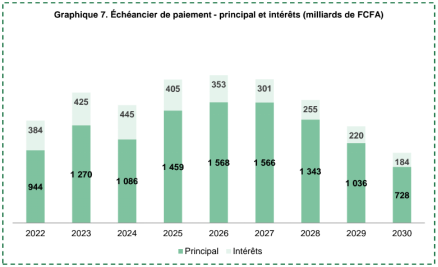
Senegal's debt payment schedule
The only objective reason that could justify early repayment is to be able to take advantage of lower interest rates to extend the maturity and reduce the debt service burden on the budget's current expenditures. Given the exponential growth of these charges and the ever-increasing level of amortization, one can doubt that this type of debt restructuring is the main objective of these premature repayments, which are made with new loans. Repetition is pedagogical: we insist that this borrowing generates colossal commissions borne by the Senegalese taxpayer.
Jub, Jubal, Jubbanti: A slogan undermined by the facts
The main platform of the opponent Ousmane Sonko was the fight against corruption and the capture of resources by a corrupt elite. This corruption has a concrete materialization in the management of public finances, not only in the use of excessive means allocated to the functioning of the state, but also in the implementation of projects carried out by the latter.
One of the pillars of the massive corruption system, put in place by previous regimes, is the creation of agencies and positions with no added value within ministerial departments and public and parapublic bodies, even within the Presidency of the Republic. The promise was made to eliminate some of these structures, and this is where it is possible to make real savings on state spending.
| Period | Workforce | Payroll (Billions of FCFA) | Hospitalization Costs (Billions of FCFA) |
|---|---|---|---|
| April 2024 | 181 301 | 114,9 | 1,1 |
| May 2024 | 181 900 | 116,0 | 1,5 |
| June 2024 | 182 449 | 116,8 | 1,5 |
Nothing has changed in the wasteful practices of the public administration. Worse, with the installation of the new teams, a considerable increase in recruitment has been observed in the civil service during May and June 2024. Indeed, a recruitment of 1,148 new agents was carried out by the new authorities in two months. The monthly civil service payroll has thus jumped by 2 billion FCFA since April 2024, rising from 114.89 billion FCFA to 116.82 billion FCFA.
Another worrying fact: hospitalization expenses for state employees, which, under the previous regime, averaged around 1 billion FCFA per month, suddenly rose to 1.5 billion FCFA. That is a 50% increase in hospitalization costs for civil servants since May 2024, without any public health context to justify it. It will also be necessary to verify if we are not dealing with a case of embezzlement of public funds, disguised as medical coverage for civil servants.
Despite the good intentions, the vision, and the proactive speeches, an examination of the facts and figures shows that the PROJECT is headed for failure, if nothing is done to quickly change the trajectory that has been set.