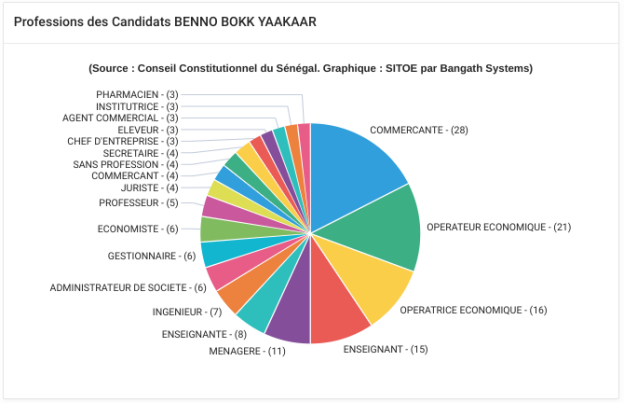
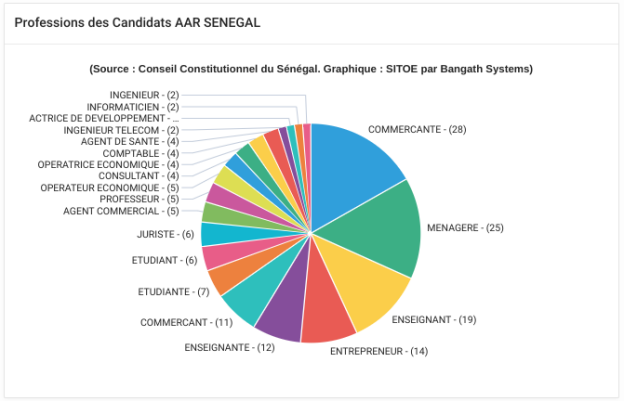
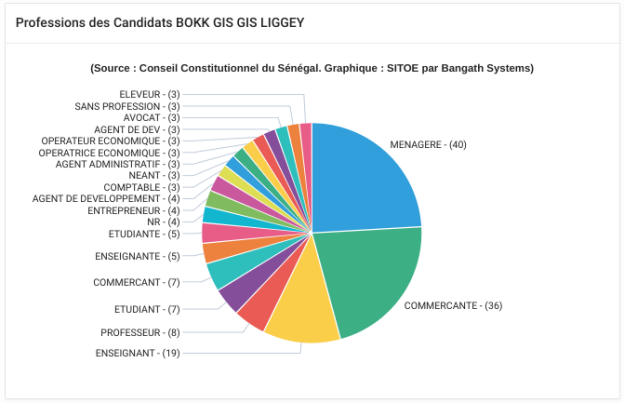
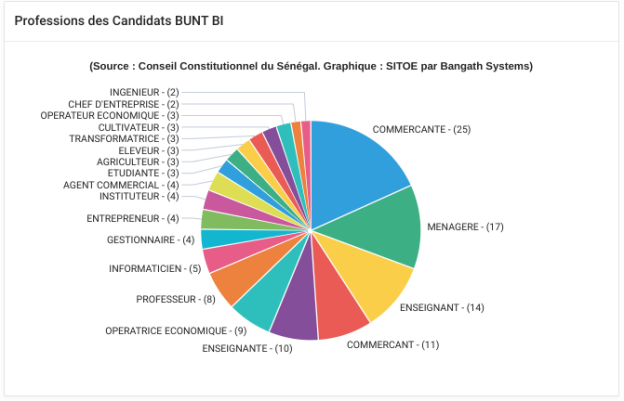
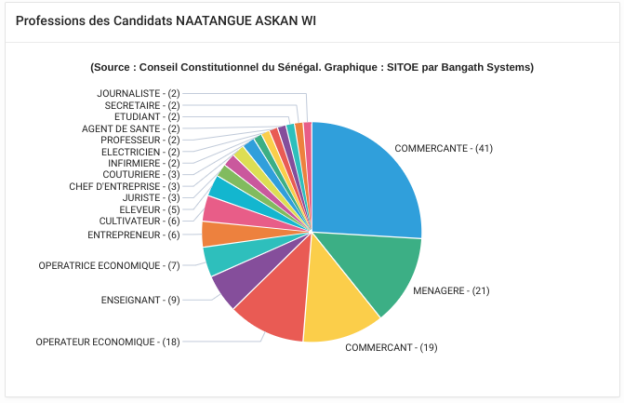
The analysis of the lists of candidates nominated for the 2022 Senegalese legislative elections reveals a major statistical anomaly which makes it possible to understand the low level observed among parliamentarians of this new legislature. The two professions most represented on these lists, as mentioned in the official publication of the Constitutional Council, are: “COMMERCANT” (212 occurrences) and “HOUSEWIFE” (164 occurrences). This is probably the same profile, which could be summarize by “BUSINESS WOMAN”. By removing the “sex” variable and merging with professions “MERCHANT”, “ECONOMIC OPERATOR” and “ECONOMIC OPERATOR”, we arrive at an overwhelming majority of candidates with a vague profession but which can be placed in the business world in the sense informality of the term. The professions “LAW” (24 occurrences), “ENGINEER” (20 occurrences) and “ACCOUNTING” (14 occurrences) following far behind, this gives a fairly precise idea of the problem.
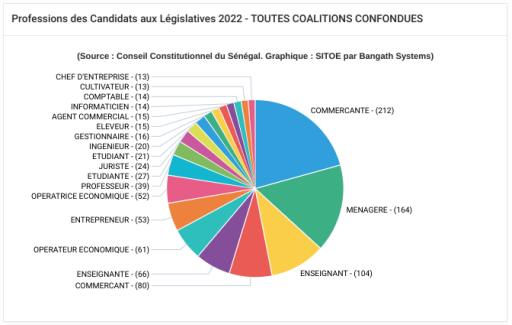
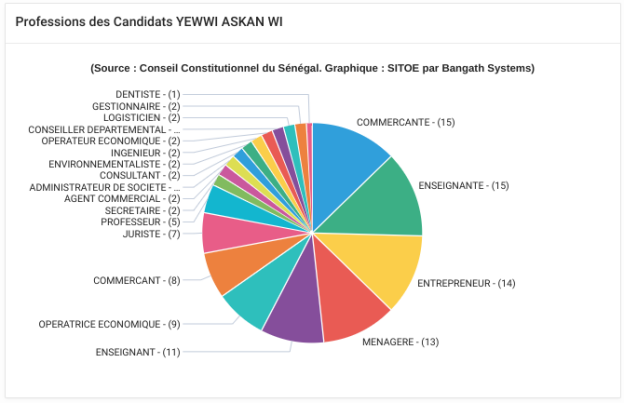
This distribution[0] is found, more or less, in all the coalitions which competed in these July 2022 legislative elections, with the exception of Yewwi Askan Wi, where the MERCHANT profession, still in the lead, is followed by the TEACHER category and the HOUSEKEEPER profile is in fourth position behind ENTREPRENEUR, another profession with random content.
Historical foundations of the parliamentary mode of representation
Article 3 of the Constitution of the Republic of Senegal provides: “National sovereignty belongs to the Senegalese people who exercise it through their representatives or through referendum."
This institutional dogma, inherited from the constitution of the French Fifth Republic - itself distant residue of the Revolution of 1789 and the theories of the Social Contract developed by thinkers like Rousseau - is the theoretical basis that legitimizes the existence of legislative power. The evolution of the notion of sovereignty, in modern political history, is indeed marked by the affirmation of an "Original Sovereign" that resides in the people. The latter delegates its sovereignty to a "Derived Sovereign", embodied by governmental structures, including the National Assembly.
Thus, in the case of Senegal, deputies, elected by universal suffrage, contribute to the embodiment of this derived sovereignty which endows them, for the duration of a legislature, with the prerogative to make decisions on behalf of the people; this transfer of sovereignty starting from a simple postulate: the decisions made by the Derived Sovereign are supposed to reflect the General Will. The mission thus assigned to the parliamentarian covers different activities sometimes schematized in the form of a triptych: Represent, Legislate, Control.
This article proposes to open a debate on the relevance of this model in the current context, to raise a cold and lucid look to evaluate it and propose an alternative model that could enable us to resolve structural problems which are obstacles to the development of our country and the emergence of a true rule of law.
Dérives du modèle actuel
The current functioning of our parliamentary democracy reveals significant flaws in this mode exercise of popular sovereignty. The National Assembly, although elected by the people, is often perceived as disconnected from his voters. Worse still, the game of majorities tends to place the Legislature under the control of the Executive, hindering the separation of powers, essential to any democracy. This phenomenon is exacerbated by the relationship of very strong dependence - food - of parliamentarians vis-à-vis the head of the Executive who, until the advent of President Bassirou Diomaye Faye, was also leader of the majority party or coalition and main provider of privileges. Thus, the genuine consideration of the aspirations of the people is not a reality in parliamentary action, as shown by the unfortunate constitutional coup attempt of February 3, 2024 and the recent upheavals in relations between the BBY parliamentary majority, resulting from the 2022 legislative elections, and the new executive, embodied by President Bassirou Diomaye Faye.
The spokesperson for the new government recently took a beating from the members of the opposition for having declared, in substance, that censoring the Sonko government would amount to not respecting the popular will. Even if Mr. Ndieck Sarré expressed himself in a manner clumsy - it must be recognized that he does not have the oratorical talent of a Seydou Gueye or an Abdou Karim Fofana - his thinking is relevant. Indeed, if the only source of legitimacy for parliamentarians is the popular will, then it is normal to expect them to submit to the most recent one, namely that which came out of the polls on March 24, 2024. Thus, respect for this will general should not only force them to refrain from any temptation of a motion of censure against the Sonko government, but they should even go further and facilitate the action of the new Executive by voting on all the texts submitted by it during this transitional period imposed by the dissolution deadlines. Unfortunately, in view of the recent act of blocking - of sabotaging - the debate budgetary orientation, which legally had to be held before the end of the ordinary session, we notes that this alignment with the very last will of the people is not on the agenda.
One of the main problems revealed by our study is the loss of quality in the profiles of parliamentarians over the years. It is common to hear that national representation is a reflection of society as a whole, a sort of “microcosm of the country”, some will say. The underlying idea being to say that if there are brilliant people and mediocre people among us, it is It is normal that we find representative samples in the National Assembly. This assertion is all the more unfair than the spectacle offered to us by our representatives on the benches of the hemicycle for several legislatures is far from reflecting the overall distribution of these characteristics in society.
It is also commonly accepted, in our country, this incredible idea that it is not necessary to know how to read and write to become an MP. And therefore, a legislator can be exempted from the ability to read, or even understand, the texts of laws that it is supposed to create, modify, delete - or, depending on established jargon, vote, revise, repeal. Thus, parliament is the only corporation where we accept the recruitment of individuals lacking the skills necessary to practice the profession. Most importantly, what is required of them is to make speeches and vote. How long will we continue with this aberration? It’s just as if we accepted in hospitals the recruitment of doctors who do not do not know how to treat the sick but whose activity is essentially limited to talking among themselves and to sign admission forms and death certificates!
The other mission devolved to the parliamentarian, in addition to those of legislating and representing his fellow citizens, is that of controlling government action and evaluating public policies. This supposes, of course, a minimum knowledge of the basic principles which govern the operation of the State, its structures, its procedures and management rules, particularly public finances. But, no worries, no need to understand all this to be a parliamentarian in Senegal. The most important is to know how to assert yourself in grassroots activism, and to be able to vote time to contribute to the balance of political power, under the leadership of a head of the Executive who sets the tone and pulls the strings, in perpetual violation of the constitutional principle of separation powers.
With complete objectivity, we can admit, to ensure the broadest possible representativeness, that there actually have profiles among the elected representatives of the people that reflect the sociological diversity of the country. We must therefore be able to find on the benches of the National Assembly farmers, fishermen, traders or breeders alongside lawyers, engineers, teachers, accountants, etc. Mays the number of elected officials who are illiterate or have a modest level of education should be contained in reasonable limits, that is to say the strict minimum, if we wanted to have a parliament efficient.
La mainmise des affairistes sur les investitures
The mayor of a large regional capital, doctor of law in his state, and other figures of the coalitions had brought out their frustration at having been sidelined, and there it was that the data tells us that they were used to favor individuals with surprising profiles, objectively much less legitimate to exercise the function of parliamentarian. An Assembly national quality should be mainly composed of lawyers or, at least, of people having solid knowledge of law, or being able to improve their skills on the subject. Former MP Théodore Chérif Monteil from the 13th legislature is a perfect illustration of this. Chemist by profession, he stood out for his mastery of legislative procedures and his ability to make it understandable to lay people. The non-re-election of such an endowed parliamentarian, intellectually and technically, compared to the entry into the hemicycle of certain individuals, constitutes in itself a bug in our electoral system, a sort of institutional security flaw on which we would benefit from seriously considering.
Proof of proven skills should be a criterion engraved in stone in the electoral code for prevent political parties from investing in anyone and encourage the emergence and election of men and quality women. Such a competency criterion would have been much more relevant and legitimate than certain abusive criteria which have, until now, had no other use than to allow the power in place to carry out political manipulation to gain an advantage over their adversaries. He is all the same question of how to choose the men and women who must decide the fundamental rules which govern our society and validate the important decisions which involve the entire Nation.
The question that comes to mind, upon discovering the statistics on the profession of candidates for legislative, is to know why the sudden interest of business women and men in the service public, despite the supposed constraints on personal life, family, business and despite all the other risks of the job? We can also question this ease for these people to obtain the nomination on lists where the war of leaders within the coalitions is usually required to obtain a place in an eligible position. The answer to these questions is without doubt to be found in what the protagonists of this singular alliance report and the profit that everyone potentially benefits.
A political coalition that invests in a merchant can gain in return a financial contribution to support its activities and an effective mobilization relay, in particular in working-class neighborhoods, in families, in markets and in the Diaspora. The diplomas, the eloquence or passion of penniless professional politicians may prove insufficient to win the nomination. In return, once elected, these honorable deputies benefit from a diplomatic passport which allows you to travel almost anywhere in the world without the usual hassle of visa applications, with the bonus of a passage through the AIBD hall of honor upon departure and, if necessary, assistance from diplomatic and consular services upon arrival. Access to high spheres of state and visibility are also a potential source of motivation. Furthermore, a parliamentarian receives a small golden medallion on the chest and a sticker on the windshield, precious sesames which, in addition to the prestige they provide in town and in the countryside, open the administration doors. Finally, parliamentary immunity, a company vehicle, compensation, thousands of liters of fuel and other privileges are all benefits that confer obtaining a deputy seat.
We can clearly see that what was supposed to be a priesthood, a gift of oneself in the service of the country, could well be become, for some people, a means of obtaining or consolidating a comfortable social position. Therefore, the defense of the interests of the “ordinary” citizen, which is only an instrument to achieve this end - a sort of stepping stone - becomes secondary. This is how successive regimes ended by causing one of the essential pillars of our institutions to regress and divert it from its objectives originals. A country that aspires to Emergence cannot afford the luxury of parliamentary regression to which we have been witnessing for several years and which has taken on worrying proportions with this 14th legislature.
Une plateforme digitale populaire pour un modèle alternatif
Faced with the abuses observed in the implementation of legislative power, which remove all its substance to the principle of popular sovereignty and render it de facto inoperative, it is imperative to rethink our democratic model. The proposed alternative is a system of direct popular consultation, inspired by the Swiss voting model but adapted to the digital age. This digital governance system popular would take advantage of the broad connectivity of citizens and technological advances to provide citizens with secure access to legislative proposals and votes.
The use of mobile phones in our country has indeed become widespread with a penetration rate greater than 100%, which can certainly be explained by the possession of more than one SIM chip by certain individuals, but also by the generalization of the use of smartphones in society. Obviously, there is many more citizens who interact with digital platforms of all kinds than of voters registered on the electoral lists.
In this model, each citizen would have the opportunity to directly participate in legislation according to the following terms:
- Voting on laws: Citizens could vote on proposed laws via a Platform Popular Legislative Digital (PNLP), guaranteeing the integrity of the legislative process and its conformity with the general interest.
- Legislative initiative: Along with the Executive, citizens could propose laws, which would be submitted to the popular digital vote, after having collected a significant number of support, via a digital petition integrated into the PNLP.
- Impeachment procedures: A mechanism would allow citizens to launch impeachment procedures dismissal against elected officials or civil servants not respecting their mandates or acting against the public interest.
Thus, the National Assembly would be abolished and replaced by a National Legislative Commission (CLN) not elected, limited to around thirty people at most. This commission would take over the part technique of steering and framing the legislative process, during a legislative session which would replace the traditional parliamentary session. Its members would be chosen from the different bodies public administration profession for their expertise, namely lawyers, tax specialists, public finance specialists, engineers, economists, planners... such as the Senegalese administration is full of them.
The selection of members of the CLN could be entrusted to the judicial institution which would co-opt them in a process similar to the selection of court jurors. They would thus be detached for the time of a legislative session and would return to their original administration at the end of it, without modification of their status and remuneration. Costs incurred by their participation in the CLN (additional travel, meals, various justifiable constraints) would be covered by the State through allocations to the legislative committee. Such allocations would obviously be very modest compared to the current budget of the National Assembly.
The parliamentary debate prior to the vote on laws would be replaced by a public debate through the audiovisual media, the written press and social networks but also in neighborhood committees and of villages. In these public discussions, supervised by administrative authorities and covered by government and private media under the supervision of the regulatory body, specialists and educators could provide insight and explain the texts discussed so that everyone can understand form a precise idea and determine your vote.
This model would also be replicated at the level of local governance to replace councils departmental and municipal, equally ineffective, costly and corruptogenic. Local elections are would limit the choice, by direct universal suffrage, without associated council, of the heads of the executives local such as mayors and, if the necessity is proven, the presidents of departments and/or region. The votes of the councils to validate the decisions of the local executives would thus leave room to votes by citizens via the digital platform.
Advantages of the proposed model
With the induced effects of the elimination or recasting of elections other than the presidential one, on the one hand, and the sharp reduction in operating expenses in the budgets of the institution parliamentarians and local authorities, on the other, this model would allow the State to save money several hundred billion FCFA over an electoral cycle. The share of budget thus recovered could be used much better in productive investment aimed at the well-being of populations than in the maintenance of a privileged caste with no real added value for the Nation.
The abolition of the National Assembly and local councils and their replacement by a system of popular consultation would not mean the end of representative democracy, but rather its evolution towards a more participatory and reactive form, freed from the control of organizations policies that have confiscated popular sovereignty for too long. This would strengthen democracy by making legislative power directly accessible to the people, thus realigning governance with the principles of the Original Sovereign, by improving transparency and accountability of decision-makers politics. This radical change would restore trust in our institutions, by placing legislative power where it draws its source: in the hands of the people.
PROFESSION STATISTICS BY COALITION