Professor Abou KANE of Cheikh Anta Diop University was the only economist, or even the only Senegalese, to publish a contribution contradicting the thesis presented in the article entitled "The Salary Bomb: The Poisoned Legacy of Macky A Diomaye”.
As a reminder, this article, published on April 5, 2024 on senenews.com and taken up by almost all Senegalese online sites, certain daily newspapers and some foreign publications, alerted on the risks weighing on our public accounts due to massive spontaneous increases in salaries of the civil service at specific times: in the run-up to national elections.
The text had been written with great care, after serious work of analysis, verification and cross-checking which lasted several months, with verifiable sources and an approach using advanced analysis and calculation tools developed specifically for this study.
A work that the FASEG teacher who, moreover, deserves all the respect he confers his quality as an economics graduate and his indisputable erudition in the subject, has surprisingly attempted to discredit. And he did it in a hastily produced paper, full of cookie-cutter formulas and “easy statements”, tinged with irony and containing a blatant contradiction, all without citing the least source or reference. Quite the opposite of the article he worked to demolish.
The professor had notably been ironic about the following passage from our text, which we stand by: "In an economy that struggles to produce wealth on an endogenous basis, and with a sluggish and very insufficient mobilization of internal resources, the only way to cover these additional personnel expenses is to resort to debt. Unless the new authorities find a miracle solution or decide to tell the Senegalese people the truth about this veritable time bomb just waiting to explode, we are set to continue this exponential indebtedness—another 'legacy for future generations' from President Macky Sall—until a possible cessation of payments, with all the risks of social and security destabilization that this entails for our country. The internal resources, budgetary grants, and other development 'aid' that we manage to mobilize, under the governance and economic policy orientations we have observed thus far, will not be sufficient to maintain this payroll over the long term."
Basically, Professor Kane asserts that the only real problem is the debt, in specifying that “Debt service (principal + interest) will increase by 44% over the next two years for reach 2600 billion in 2026. As things currently stand, I do not think that the payroll can constitute a burden for the new regime. I even think that it should be increased by recruiting more qualified young people in the public service and by further motivating agents already in office…”
The unbridled debt of our country, everyone agrees, is obviously a very big problem, more over raised in the attacked article. But the existence of a particular problem, whatever its magnitude, does not erase all the others. We have a multitude of problems, the mass salary is one. A problem caused by the irresponsibility and political fraud of the late regime and, to a lesser extent, those who preceded him. It must be addressed with responsibility and lucidity and do not brush it aside by asserting that on the contrary we must inflate this mass salary more. A government that inflates the wage bill in an artificial, unfounded manner economically valid but guided by electoral calculations, it is serious enough; an economist renowned and very media-oriented, a teacher moreover, who justifies and encourages such a policy, it is even worse.
We had drafted a right of reply exposing the lack of intellectual rigor noted in the article entitled “You Said Salary Bomb?”, pointing out the weakness of the analysis, the factual errors and unsubstantiated assertions that are being undermined by the facts. Our hasty contradictor declared himself, a few weeks later at 1 p.m. on RTS, reporting the service from debt to exports and budgetary revenues, that “Senegal is in a red zone [which makes] a country that may no longer be able to honor its commitments.”
A relative convinced us not to publish this right of reply, written first intentional and much less restrained and measured than the text you have in front of you. As a big brother benevolent, we therefore decided to listen to this relative, no less benevolent! But, it would be however interesting to ask this economist and those who applauded him in the comments section of his social networks, in particular those of them who, like him, have a clear conflict of interest on the subject, to explain to us how and where we will find enough to pay public sector salaries without drawing on cash resources, in other words Eurobonds and other loans which we cost an arm and a leg.
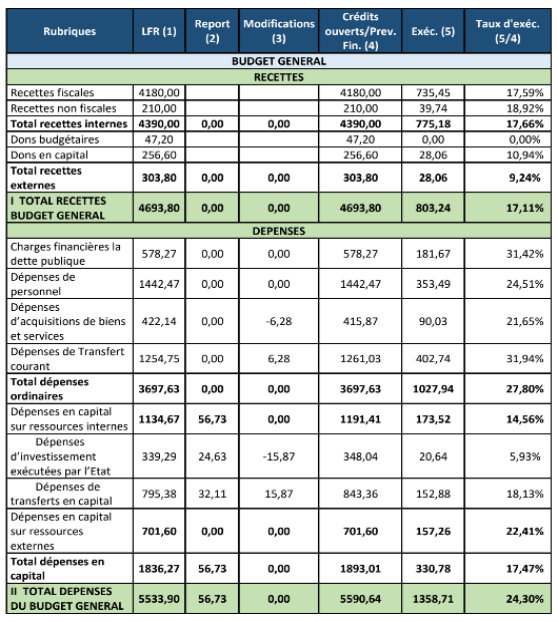
(In billions of FCFA. Source: RTEB Q1 2024 Directorate General of the Budget)
The new government which, according to Bloomberg, has just carried out an emission of 450 billion FCFA of Eurobonds, has clearly not yet found the solution to this problem, if we are to believe this summary table, taken from theQuarterly Budget Execution Report for the 1st quarter 2024(read LFI and not LFR).
This report indicates a revenue recovery rate (internal and external combined) at 17.11% and an expenditure execution rate of 24.30%. Which means we spend much faster that we bring money into the coffers.
It should also be noted that, as usual under the Sall regime which executed this first tranche of the budget, operating expenses (27.80% execution rate, beyond the quarterly forecast) which include the payroll, have further nibbled on expenses investment (17.47%, well below forecast), which explains many of our concerns.
We can clearly see in this budget execution report, the danger on which we alerts in The Salary Bomb are becoming clearer. This bomb is still there, not yet defused and ready to explode at any moment, if the radical change in budgetary policy, essential for putting our public accounts in order has not been started. And it starts with the vote of a law of urgently amending finances.